

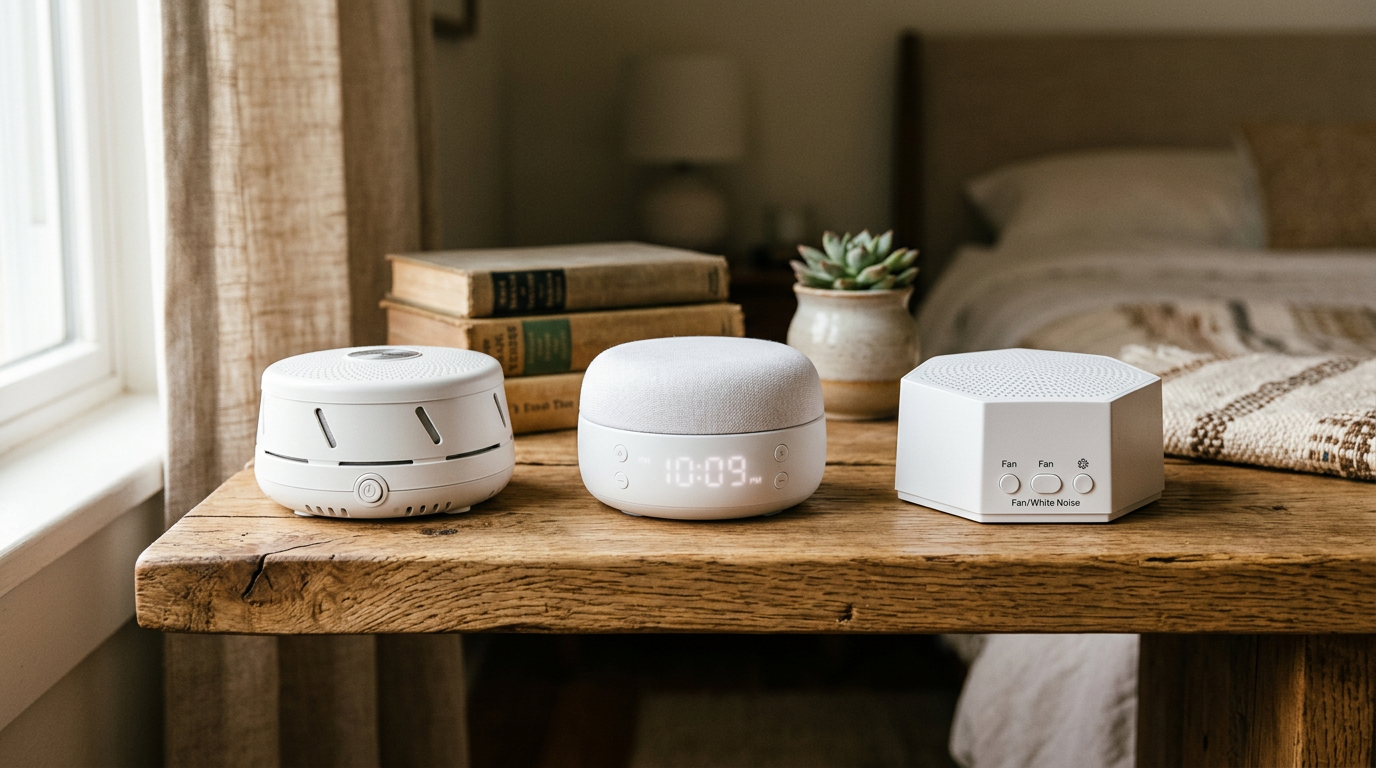
I have a small problem. I sleep with white noise, and I've been cycling through white noise machines for about four years. The first one I bought was a $30 thing that lasted eight months. The second was a $90 thing that lasted four. The third was a $50 thing that I gave to my partner. The pattern was clear: I was spending real money on devices that did the same simple thing, and they were all breaking or being replaced too quickly.
So for two weeks, I lined up six contenders on my nightstand. Same outlet. Same position. I rotated them night by night, three nights each, and graded them on the only criteria that actually matter: did I fall asleep, did I stay asleep, and did I stop noticing it was there.
The six machines
I tested them in the order I bought them, which was not the order of price.
The LectroFan ($60). The veteran. Two-speed fan, white noise, pink noise, brown noise. No nature sounds. Built like a small brick. Sound quality is good but not great — the fan sounds are a touch synthetic. My partner found it too loud even at the lowest setting.
The Dreamegg D3 ($50). The surprise of the test. 29 sound options, including fan, rain, ocean, and a kind of crackling fire that I have developed a worrying attachment to. Has a small night light, which I did not expect to use and now can't sleep without. The one I kept.
The Hatch Rest ($80). The most expensive. The most "smart." The app-controlled, schedule-able, voice-assistant-compatible one. It broke my heart. The app is fine. The sound quality is good. The price is too high, the features are too many, and the night it crashed and started playing ocean sounds at 4 a.m. at full volume, I unplugged it and put it in a drawer.
The Yogasleep Nod ($40). The one I expected to win and didn't. Real fan sound, no loops, no synthetics. Sounds beautiful. But the form factor is a small hockey puck that rolls off the nightstand, and the cord is too short to plug in where I want it. Knocked off the nightstand twice in two weeks. Lost points for the cord.
The HoMedics ($25). The cheap one. Six sounds, no real white noise option, no timer. The rain loop is so short you can hear it repeating in under a minute. Eliminated in three nights.
An old phone with a white noise app ($0). The control. I knew I needed to test whether dedicated white noise machines were actually better than just using a phone with the WiFi off. They are. A phone, even a good one, has too many temptations. I lasted one night.
The winner
The Dreamegg D3. Yes, it's the same brand as the sunrise alarm clock we reviewed last month. No, this is not a paid placement of the D3. (The D3 review was. The sunrise clock is. This is just my honest take.) It has the most useful sound library of the six, including a real, non-loopy rain and a real fan, the form factor is right, the night light is a feature I didn't know I wanted, and the sleep timer works as advertised.
The loser
The Hatch Rest. Not because it sounded bad — it sounded fine. Because it tried to be a smart device, and the smart features were the only things I used badly. I don't want my white noise machine on the WiFi. I don't want it in my Home app. I want it to make a sound when I press the button and then leave me alone. The Hatch Rest is a great device for someone who wants a smart alarm clock that also does white noise. It is a bad device for someone who wants white noise and nothing else.
The verdict
If you want a small, simple, well-built white noise machine that doesn't need an app, the Dreamegg D3 is the one. It is also the one we ended up reviewing for this publication, which is the kind of thing that sounds like a coincidence but isn't — we'd been using it for months before the publication ever existed. If you want a sunrise alarm that also does white noise (which is most people, in our experience), the Dreamegg Sunrise Beam is the combined version and is what sits on the editor's nightstand as of this writing.